Signs Your Mini Split Is Low on Refrigerant
Weak cooling, ice on the coil, and hissing lines mean your mini split is low on refrigerant. Here's how Rosenberg homeowners confirm a leak and fix it.
The clearest signs your mini split is low on refrigerant are weak cooling, ice building on the indoor coil, and a faint hissing or bubbling sound near the line set. If your ductless system runs constantly but never reaches the temperature you set, refrigerant loss is one of the first things we check. Below, we walk through every symptom, explain why leaks are so common in this part of Texas, and show you how to tell the difference between low refrigerant and a dirty filter or a failing compressor.
What Low Refrigerant Actually Means for Your Mini Split
Low refrigerant in a mini split is a sealed-system pressure problem that happens when refrigerant escapes through a leak, not when the system "uses up" its charge over time. A ductless system is a closed loop. The refrigerant inside it never burns off, never gets consumed, and never needs topping off under normal operation. If the charge is low, refrigerant left the loop through a hole, a bad flare connection, or a failed valve.
That distinction matters because it changes the repair. Adding refrigerant without finding the leak is a temporary patch. The system will lose the new charge again, usually within weeks to months, and you will pay for the same visit twice. Real Refrigerant Leak Repair and Recharge Rosenberg TX means locating the leak, repairing it, pressure-testing the line set, pulling a deep vacuum, and then charging by weight to the manufacturer's spec.
Your mini split holds roughly 1 to 3 pounds of refrigerant in a single-zone setup, and multi-zone systems can hold 5 pounds or more. Losing even 10 percent of that charge is enough to drop cooling capacity noticeably on a 95-degree afternoon.
The Most Common Signs Your Mini Split Is Low on Refrigerant
Signs your mini split is low on refrigerant show up in the way the system cools, sounds, and behaves at the indoor head. Watch for these together, not one at a time, because a single symptom can have several causes.
- Weak or warm air from the indoor head. The unit runs, the fan blows, but the air feels barely cool or room temperature.
- Ice on the evaporator coil or the copper lines. Frost or a solid block of ice forms on the indoor coil, sometimes creeping onto the larger suction line.
- Hissing, bubbling, or gurgling near the line set. That is refrigerant escaping or flashing as pressure drops.
- Long runtimes with no temperature drop. The compressor never cycles off because the system cannot hit setpoint.
- Higher electric bills. A system running two to three times longer than normal shows up on your meter within one billing cycle.
- Oil residue or grime at flare fittings. Refrigerant carries compressor oil, so a leak often leaves a dark, oily stain at the connection.
If you are seeing warm air specifically, our Mini Split Not Cooling Repair Rosenberg TX page covers the full diagnostic order we run, from airflow to charge to compressor amp draw.
Ice Buildup Is a Symptom, Not the Problem
Ice on the coil is the most misread sign on this list. Homeowners often assume the system is "freezing because it is working too hard." In reality, low refrigerant drops the pressure at the evaporator, which drops the coil temperature below 32 degrees, and condensation freezes on contact. A coil that ices over also chokes off airflow, so cooling gets worse the longer you run it. We handle that pattern under Frozen Coil and Ice Buildup Repair Rosenberg TX, and we always verify the charge before we call the job done.
Why Mini Splits in Rosenberg, TX Lose Refrigerant
Mini splits in Rosenberg, TX lose refrigerant mostly through flare fittings, vibration, and the heat-and-humidity cycle that defines Fort Bend County summers. We are in a Gulf Coast climate with summer highs that sit between 94 and 100 degrees for weeks and humidity that rarely drops below 70 percent. That combination stresses every connection in the system.
Three failure points account for most of the leaks we find:
- Flare connections at the indoor and outdoor units. A flare that was over-torqued, under-torqued, or cut at the wrong angle will seep refrigerant slowly for years before you notice.
- Vibration wear on the line set. Copper lines rubbing against a stud, a wall penetration, or a zip tie will eventually thin and crack.
- Schrader valves and service ports. These tiny seals harden with age and heat, and they are a common slow-leak source on systems that are 8 to 12 years old.
Newer construction across Mini Split Repair in Briarwood Crossing and other fast-growing subdivisions tends to see flare-fitting leaks first, because installers are moving quickly and a fraction of a turn on a flare nut matters. Older homes near the historic downtown grid more often show line-set abrasion and valve wear.
How to Tell If Your Mini Split Is Low on Freon in Texas
How to tell if a mini split is low on Freon in Texas comes down to three checks you can do safely, plus one that requires gauges. Start with what you can see and hear, then let a technician confirm with instruments.
Check one: filter and airflow. Pull the indoor filter. If it is matted with dust, clean it and run the system for 30 minutes. A clogged filter mimics low charge by starving the coil of air, and it is the cheapest thing to rule out.
Check two: temperature split. With an infrared thermometer, measure the air at the return and at the supply vent after 15 minutes of runtime. A healthy mini split delivers a 16 to 22 degree drop. If you are seeing 8 degrees or less, the charge or the compressor is suspect.
Check three: visual and audible. Look for ice on the indoor coil and oil staining at the flare nuts. Listen for hissing at the outdoor unit when the compressor shuts off.
What you should not do is hook up a set of automotive gauges or a can of refrigerant from a big-box store. Mini splits use R-410A or R-32 depending on age, they run at much higher pressures than car AC, and overcharging by even a few ounces will damage the compressor. Our Mini Split Error Code Diagnostics Rosenberg TX service reads the fault codes that many inverter units throw when pressure sensors detect an abnormal charge.
What to Watch Out For: Common Mistakes Homeowners Make
The most expensive mistake we see is adding refrigerant without finding the leak. It feels like a fix because the system cools again for a few weeks. Then the charge drops, the compressor starts running hot, and you are looking at a compressor replacement instead of a $200 to $400 leak repair.
Other patterns that cost Rosenberg homeowners money:
- Running the system with a frozen coil. Ice insulates the coil, liquid refrigerant returns to the compressor, and that is how compressors die.
- Assuming a recharge is a maintenance item. It is not. A sealed system that needs refrigerant has a leak, full stop.
- Ignoring a slow leak for a full season. A system that is 15 percent low in May will be 40 percent low by September, and the damage compounds.
- Letting anyone add "a little Freon" without a leak search. Ask what test was run and what pressure the system held.
If your system has already been running low for a while, the compressor may be stressed. We evaluate that under Mini Split Compressor Repair Rosenberg TX before recommending any replacement.
When to Call a Professional
Call a professional the moment you see ice on the coil, hear hissing at the line set, or measure a temperature split under 10 degrees. Those three signs together point to a refrigerant leak that will not resolve on its own, and every day you run the system in that condition adds wear to the compressor.
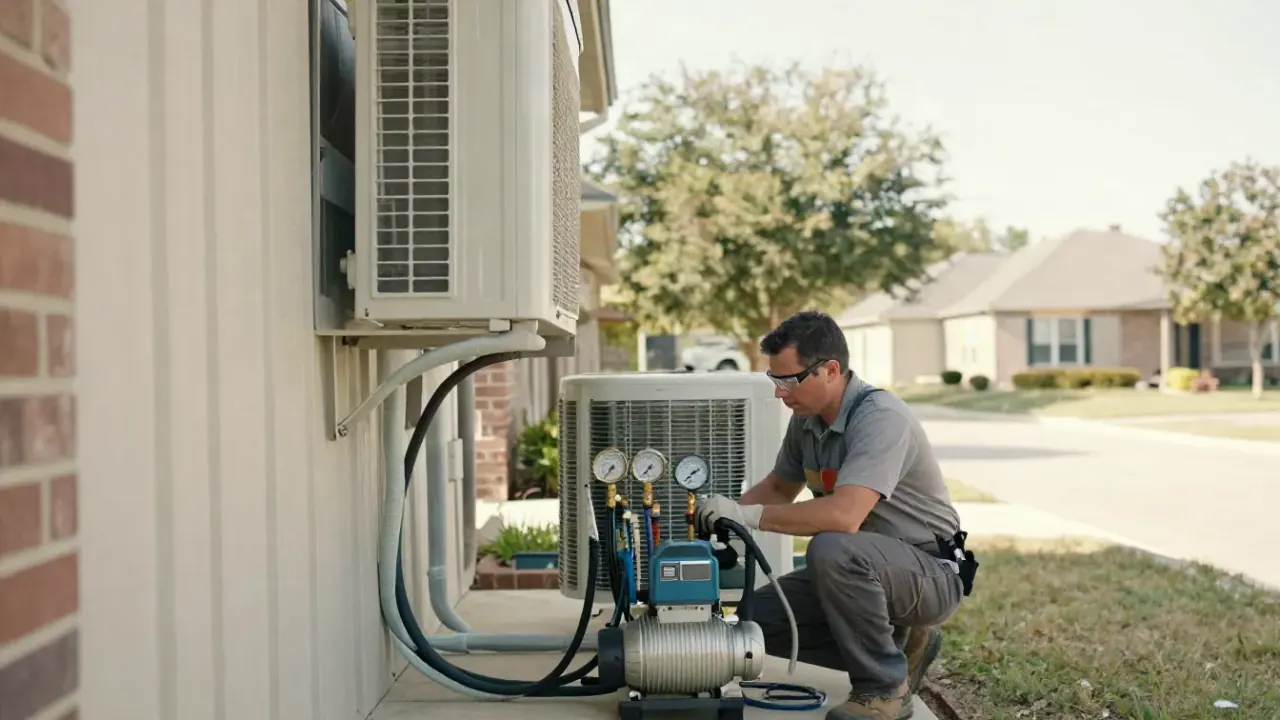
Our team handles the full job: electronic leak detection, nitrogen pressure testing, flare repair or line-set replacement, vacuum to 500 microns, and a weighed charge to the manufacturer's spec. We also check the condensate drain while we are there, since a system running long cycles in Rosenberg humidity pushes more water through the drain line than usual. Typical 2026 pricing in this area runs $250 to $450 for a leak search and repair on a single-zone system, plus $75 to $150 per pound of refrigerant, and multi-zone systems run higher because there is more line to test.
If you are not sure whether the problem is the charge or something else, our Mini Split Cleaning and Maintenance Rosenberg TX visit includes a full performance check that will tell you exactly where the system stands.
Frequently Asked Questions
What are the signs my mini split is low on refrigerant in Rosenberg TX?
Weak cooling, ice on the indoor coil, hissing near the line set, long runtimes, and higher electric bills. If two or more of those show up together, especially in summer, low refrigerant is the leading suspect. A technician confirms it with gauges and a temperature split reading.
How much does refrigerant recharge cost in Rosenberg Texas?
Expect $250 to $450 for the leak search and repair on a single-zone system in 2026, plus $75 to $150 per pound of R-410A or R-32. Multi-zone systems cost more because there are more connections to test. The recharge itself is the smaller part of the bill.
Can I just add refrigerant to my mini split in Rosenberg?
No. Adding refrigerant without repairing the leak is a temporary fix that fails within weeks, and overcharging a ductless system can destroy the compressor. Texas also requires EPA Section 608 certification to handle refrigerant. Find the leak first, then charge by weight.
How do I know if my ductless AC has a refrigerant leak in Texas?
Look for oil residue at the flare fittings, listen for hissing when the compressor stops, and check for ice on the indoor coil. A system that needs refrigerant added more than once has a leak. Electronic leak detection and nitrogen pressure testing confirm the exact location.
How long can I run a mini split that is low on refrigerant?
Days, not months. A low charge makes the compressor run hotter and longer, and a frozen coil can send liquid refrigerant back to the compressor. Shut the system down and call for service if you see ice or hear hissing.
Get Help with Mini Split Repair in Rosenberg
If your mini split is blowing warm, icing up, or hissing, we can find the leak and get the charge right the first time. Call Rosenberg Mini Split Repair at (281) 738-1427 and we will schedule a diagnostic at your home.